Historical BackgroundThe Department of Emergency Medicine and Critical Care (EMCC) is more than a clinical service. It is a team of professionals who come together every day to care for patients at some of the most critical moments of their lives, while also training the next generation of emergency and critical care professionals. The Department of Emergency Medicine and Critical Care (EMCC) was established in March 2009 E.C. as a dedicated academic and clinical department. At its establishment, the department began its work with six general practitioners and one specialist physician, providing emergency and critical care while also taking responsibility for teaching and professional development.
Since its establishment, the department has continued to grow in clinical service, postgraduate education, undergraduate teaching, professional development, research, quality improvement, and community service. Today, EMCC provides continuous, time-sensitive care for patients with acute illness and injury and supports the development of emergency and critical care capacity in Western Oromia. Our Service Volume and ImpactThe hospital has provided emergency and critical care services since it began operation in May 2009 E.C. The departmental reference records the following service volume for 2018 E.C.: · 9,935 patients received Emergency Department care during the year. · 391 patients were admitted for inpatient critical care. · 273 ICU patients (69.8%) recovered and were discharged home. · 118 ICU patients died, corresponding to an ICU mortality rate of approximately 30%. · The reference further reports that Emergency Department mortality had been reduced to below 1%. These figures demonstrate both the high volume of acute-care patients served and the department’s contribution to timely emergency and critical care in the region. Our Vision and MissionVisionWollega University, Emergency Departemnt aspires to be one of the top ten Best Emergency Department in Africa by 2042.Mission1. Provide timely, safe, compassionate, and evidence-based care to patients with acute illness and injury. 2. Recognize and stabilize critically ill patients early through effective triage, resuscitation, airway management, monitoring, and coordinated referral. 3. Train competent and compassionate emergency medicine and critical care professionals. 4. Create an environment where learning, teaching, research, and quality improvement are part of everyday clinical practice. 5. Strengthen emergency preparedness and extend emergency-care knowledge into the community and prehospital setting.
Our current staff profileEmergency and critical care is fundamentally a team effort. Our department brings together physicians, residents, general practitioners, nurses, and other professionals who work together to respond to emergencies, care for critically ill patients, and support learners.
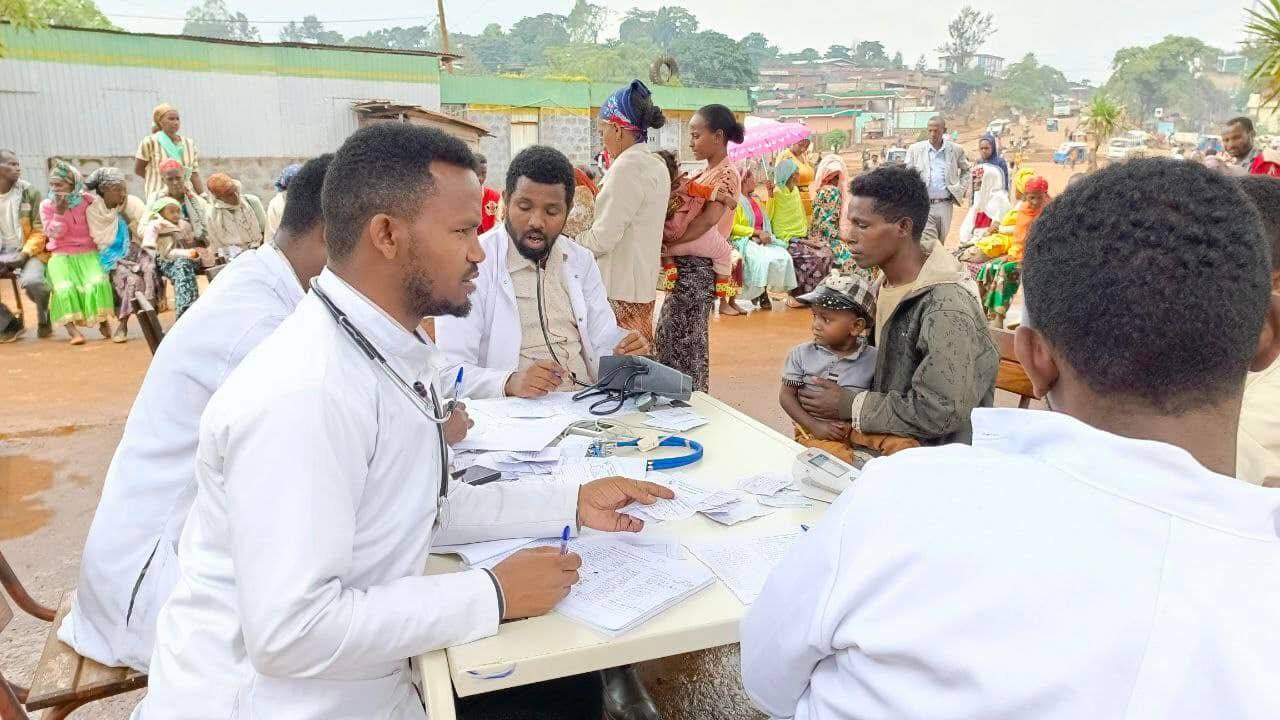
We are committed to developing our people through practical training, mentorship, continuing professional development, simulation, research-methodology activities, and opportunities to strengthen clinical teaching and supervision. Emergency care· Emergency triage and prioritization. · Rapid assessment and stabilization of critically ill patients. · Adult medical and surgical emergencies. · Trauma and injury care. · Emergency airway management and respiratory support. · Cardiovascular emergencies, including cardiac arrest and acute coronary syndromes. · Neurological emergencies, including stroke, seizures, and altered consciousness. · Poisoning and toxicological emergencies. · Sepsis and infectious disease emergencies. · Emergency procedures, resuscitation, and coordination of referral and consultation. Critical care· Care of critically ill medical and surgical patients. · Management of severe sepsis and septic shock. · Management of respiratory failure and acute respiratory distress syndrome. · Mechanical ventilation and respiratory support. · Management of severe neurological emergencies and traumatic brain injury. · Management of severe poisoning and toxicological emergencies. · Hemodynamic monitoring and resuscitation. · Management of severe metabolic and electrolyte disturbances. · Post-resuscitation care and support of patients with multiple organ dysfunction. Education, Training and Community ServiceTeaching is an important part of who we are. We believe that every emergency can also be an opportunity to learn, improve practice, and build the skills of the next generation of healthcare professionals. · Emergency Medicine and Critical Care residency training. · Undergraduate medical student teaching. · Internship and clinical attachment supervision. · Bedside teaching and case-based discussion. · Journal clubs, seminars, academic conferences, and morbidity and mortality review. · Simulation and procedural skills training. · Clinical research and quality improvement activities. · Training-of-Trainers (TOT) on strengthening community-based emergency and prehospital care for healthcare professionals working outside the hospital. One of our important community-focused activities has been the provision of Training-of-Trainers (TOT) on strengthening community-based emergency and prehospital care for healthcare professionals outside the hospital. Through this initiative, the department contributes not only to care within WUCSH, but also to strengthening the wider emergency-care system. The goal is to improve early recognition of emergencies, appropriate initial response, timely referral, and continuity of care before patients reach hospital. |
What We DoOur work begins when a patient arrives with an emergency. We aim to recognize danger sign early, start treatment without unnecessary delay, stabilize the patient, and coordinate the next step of care. Academic and Clinical Achievements1) Establishment and implementation of the EMCC residency training program. 2) Development of a postgraduate learning environment for emergency medicine and critical care. 3) Ongoing supervision and training of EMCC residents. 4) Regular academic teaching, case discussions, seminars, journal clubs, and clinical learning activities. 5) Simulation-based resuscitation and procedural skills development. 6) Training-of-Trainers (TOT) on community-based emergency and prehospital care for healthcare professionals outside the hospital. 7) Provision of continuous emergency and critical care for patients with acute and life-threatening conditions. 8) Participation in quality improvement and patient-safety activities. 9) Promotion of research and academic development. Quality and Patient SafetyWe believe that quality improvement is not a one-time project; it is a way of working. The department uses practical review, audit, feedback, and teamwork to identify problems and improve care. · Triage quality and early recognition of critically ill patients. · Resuscitation and crash-cart readiness. · Airway management and procedural competence. · Critical care monitoring and documentation. · Medication safety. · Referral and consultation communication. · Clinical audits of high-risk or high-volume conditions. · CAUTI prevention, sepsis pathway improvement, infection prevention, and documentation quality. Equipment and Infrastructure: Where Support Can Make a DifferenceEmergency medicine is highly dependent on functional equipment. A skilled team can save lives, but the team also needs the right tools at the right time. The department therefore welcomes partners who can help strengthen essential equipment and infrastructure.
Key Challenges and Partnership Priorities· Limited availability of functional mechanical ventilators in the Emergency Department and ICU. · Nonfunctional or insufficient patient monitoring equipment. · Need of emergency medication timely · Need for a functional Emergency Department isolation area. · Need to improve ICU isolation capacity and functionality. · Need for Emergency Department renovation and service expansion. · Need for additional emergency and critical care specialists and trained nurses. · Need for stronger simulation and procedural training capacity. · Need for improved academic and working space for residents and staff. Why Partner With Us?Every day, patients arrive at our Emergency Department at moments when time matters most. Our responsibility is to respond quickly, treat patients safely, support families, and give critically ill patients the best possible chance of recovery. At the same time, we are building a department that does more than provide bedside care. We train future specialists, support other healthcare professionals, take emergency-care knowledge into the community, participate in research, and continuously look for practical ways to improve the quality of care. A partnership with the EMCC Department is therefore an opportunity to make a direct contribution to patient care while also helping build sustainable emergency and critical care capacity in Western Oromia. · Improve access to life-saving emergency and critical care. · Strengthen the capacity of a teaching hospital serving the surrounding population. · Support the education and training of future EMCC specialists. · Strengthen emergency and prehospital care beyond the hospital. · Support research, innovation, quality improvement, and evidence-based practice. · Build sustainable local capacity. Our FutureOur ambition is simple but important: to build an emergency and critical care service that our patients can depend on, that our learners are proud to train in, and that our partners can confidently support. We will continue to strengthen clinical services, postgraduate education, research, quality improvement, staff development, emergency preparedness, and community-based emergency care. With committed teamwork and the support of our university, hospital leadership, government, and partners, we believe the department can make an even greater contribution to the health of the people of Western Oromia and beyond. Together, we can strengthen emergency care, build local capacity, and save more lives. Contact and Partnership InformationDepartment of Emergency Medicine and Critical Care (EMCC) Telephone:251921546965
|

About Us




Contact Us
-
Address: Wollega Nekemte, Ethiopia
-
Phone: +251 576 61 79 81
-
Fax: +251 576 61 79 80
-
P.O.Box: 395
-
Email: info@wuihs.edu.et
-
Office Hours: Monday to Friday: 8:00 AM - 5:00 PM